What's in a name ? Like many other church lands throughout the country at that time, some of the possessions described in the Inquest had probably passed into the hands of laymen, but were no doubt restored, as most of the lands specified can be identified among those subsequently belonging to the bishopric. Those adjoining Glasgow, so far as identified, were situated to the east of the Molendinar Burn. It seems to have been considered unnecessary to mention the site of the Cathedral and Glasgow itself, unless such possessions are included under designations that have not been recognised. All around Glasgow the lands not belonging to the Church seem to have been part of the royal domain, and the whole of that territory was disposed of by King David before the close of his reign. Rutherglen was erected by him into a royal burgh, with the privilege of trade over a wide district, extending on the west to th...
Posts
- Get link
- X
- Other Apps
The reformation and the University. The University was originally founded in the year 1450 by a Bull of Pope Nicholas V. obtained at the request of King James II. Bishop Turnbull, who then held the See of Glasgow, and his successors, being appointed chancellors of the new institution. A body of statutes for its government, were prepared by the bishop and his chapter in 1451, from which we learn, that it at this time consisted—besides the chancellor—-of a rector and four masters of faculties. Upwards of one hundred members were incorporated by the rector within the first two years—most of whom were belonging either to the secular or regular bodies of clergy. For some time, however, the institution appears to have had little more than a nominal existence; it had no property of any kind bestowed upon it; nor were lectures read in any of the sciences. Afterwards, however, lectures were read on theology, and the civil and canon law, in the chapter-house belonging to the...
- Get link
- X
- Other Apps
Archiepiscopal palace. ( or Archbishops Castle) Glasgow This venerable relic of the “ olden time,” was the town residence of the Archbishops of Glasgow,for many centuries the proud scene of their feudal grandeur and magnificence. It stood immediately to the west of the Cathedral, which is situated in an elevated part of the Town. The castle stood where the royal infirmary stands today. During the turbulent period of the feudal ages, when 'power'was the only law, and the mandates of governments were but little attended to, because they seldom could be enforced; when every feudal lord sought the preservation of his own rights, and, so far as he could, the redressing of his own supposed wrongs, the great objects to be attained in domestic architecture, were strength, and the power of resistance. The clergy, during these ages, notwithstanding their professions of piety and humility, were as ambitious, and fond of power as the most rude and warlike of the iron-clad barons; and n...
- Get link
- X
- Other Apps
# 10 View of Pear tree well From Views and Notices of Glasgow in Former times, by William Simpson, 3 scrapbooks. n.p. 1871 This view looks at Pear Tree Well, on the banks of the Kelvin. Regarded as a popular area for picnics, it never possessed any pear trees. It was eventually incorporated into the Botanic Gardens at the end of the 19th century. The river Kelvin rises in the Kilsyth Hills and flows past Kirkintilloch and Maryhill, through the Botanic Gardens and joins the Clyde at Partick. It was crossed by a ford until the first bridge was built in 1601. Shipyards were developed on each bank.
- Get link
- X
- Other Apps
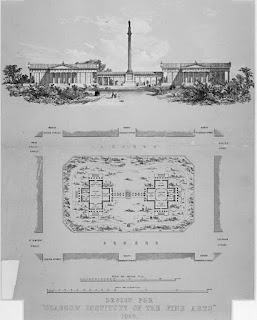
A Plan for George Square From Prints Collection held in History and Glasgow Room This is a plan of the proposed building which was to house the Glasgow Institute of the Fine Arts and be built in George Square. The building was to contain several galleries for paintings and sculptures as well as a lecture hall, school and a library. The first society for art was founded in 1821 by Alexander Findlay, a print seller, who exhibited from his shop. After it failed several other societies were started, which also failed. The Glasgow Institute of Fine Arts was eventually established in 1861.
- Get link
- X
- Other Apps
St Mungo (4) Story of the mound of Dovehill DURING the sojourn of St. Mungo in Wales, which is said to have lasted for eleven years, civiI war raged in the kingdom of Cumbria, or Strathclyde; but a decisive battle at Arthuret, on the borders of Dumfriesshire and Cumberland, or, as some think, at Airdrie, settled the dispute in favour of Roderick the Bountiful, who, it is said, had been baptised by St. Patrick in Ireland. One of the first acts of his reign was to send to St. Mungo in Wales, praying him most urgently to return. The saint complied with his request, and his re-entry was one of triumphal rejoicing. Either at the time of his return, or shortly after it, St. Mungo was preaching to the people on a plain, but as he could not he seen or heard by a large portion of the multitude, he manifested his miraculous power by causing the ground on which he stood to rise up to a mound, and he then continued his remarks, to the better edification of his hearers. Trad...
- Get link
- X
- Other Apps
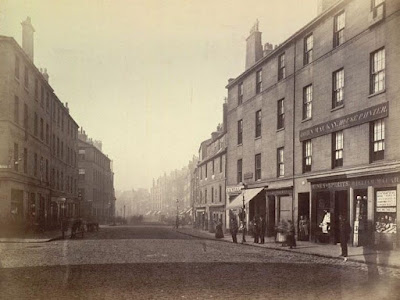
# 9 Gallowgate at Kent street, Glasgow A photograph by Thomas Annan of Glasgow (1829-1887) This view is taken from the centre of Gallowgate just before Kent Street, looking west. This is the fringe of the area that was due for demolition. Most of the buildings are solid tenements built within the previous thirty years. On the right are several people watching the camera. They stand on the pavement in front of several shops or at the entrance to a close. Above the shops, there is a prominent sign for 'John MacKay House Painter'. Albumen print, from collodion negative. These photographs were taken for the City Improvements Trust who, in the 1860s, planned to demolish the worst of the decayed city centre. They were published at different dates and in different formats by the city and by Annan's firm.
- Get link
- X
- Other Apps
What's in a (street) name? The following is not a complete street name directory of old Glasgow. Abercrombie Street. See Bellgrove. Adam's Court. Built subsequently to Jamaica Bridge by John Adam (1767-1772?). See Jamaica Bridge John Adam built a number of antique-looking buildings in Argyle Street He was also the contractor for the first Jamaica Street footbridge (1768). Adelphi Street. The Clyde frontage was called Adelphi in honour of the Brothers Hutcheson . Albion Street Opened 1806. See Greyfriars Wynd (North Albion Street), and Grammar School Wynd (North Albion Street). Albion Street Chapel-the minister in 1794 was the Rev. James MCLeod. Anderston. Village was formed in 1725 by Anderson of Stobcross upon one of his unproductive farms. Bishop Street, Anderston-James Monteith of this street was the first who warped a muslin web in Scotland. Long before steam mills were introduced into Scotland for spinning cotton, in 1792, Mr. Monteith purchased "bird...
- Get link
- X
- Other Apps
St Mungo (3) St. mungo's Journey to Glasgow. HOLDING on his way, Kentigern, '' on the same night in which he departed from St. Serf, was lodged, at a place supposed to be Carnwath, in the house of Fergus, an aged Christian, who, Simeon-like, is said to have received a "revelation that in the presence of the holy Kentigern he should pass away from the world. And when be was dead the blessed Kentigern . . . laid his body on a waggon, to which he yoked unbroken oxen, with no one to guide them: and so, following the waggon, he arrived at a place which is called Glasgow, where he buried the body, and where, serving God, he, by divine revelation, took up his abode." The body of Fergus was buried beneath some ancient trees, near a forsaken cemetery that had been consecrated by St. Ninian. On that very spot it is said was afterwards reared the transept of our noble Cathedral, and the aisle or crypt of which was dedicated to Fergus. St. Mungo and King Morken MORKEN, ...
- Get link
- X
- Other Apps
#8 Ladywell St Glasgow (1849) From Relics of Ancient Architecture and other Picturesque Scenes in Glasgow, by Thomas Fairbairn, Glasgow 1849 This view looks along Ladywell Street to the Cathedral. This street stood in an area known as 'The Butts'. It was also known as 'Hangman's Brae'. It was in this area in 1787 that the Calton Weavers, during their strike, fought with the military. Dedicated to St Kentigern, or St Mungo as he is known, there has probably been an ecclesiastical building on this site since before 603 A.D., when Mungo was buried here. The earliest part of the present building dates from 1197 when Jocelyn was Bishop.
- Get link
- X
- Other Apps
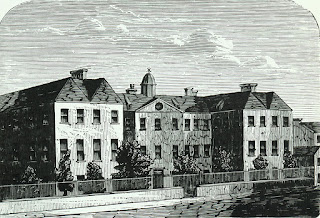
POVERTY IN 19th CENTURY SCOTLAND This engraving from the 1830s shows the Town's Hospital and Poorhouse, built in 1733 on Great Clyde Street The economic and social changes ushered in by industrialisation dramatised the problem of poverty in Scotland by concentrating it in large pockets within the rapidly growing urban centres. The boom and bust economics of the free market added to the problem as it brought with it periodic mass unemployment which in a pre-welfare society left thousands of workers in poverty. The extent of the social devastation of mass unemployment in Victorian Scotland can be grasped from a comment by the Provost of Paisley made at the height of the 1842 depression: "Unemployment was the rule .... few workmen of Paisley were employed: they were broken up and found to be wandering about in every town in the country, begging for bread, independent of those thousands whom they had at home supported by charity". Obviously the periodic occur...
- Get link
- X
- Other Apps
Trongate and the surrounding area. AT the time when King William authorised Bishop Joceline of Glasgow to have a Burgh that descriptive term had lost much of its original signification of a Fort, under the protection of which a market could be safely held. It had rather come to imply a market town, equipped with all the usual trading and judicial accessories. In accordance, therefore, with the practice of the period the privileges conferred by the Glasgow charter relate specially to a weekly market and the customs derivable from it. By one of William's statutes it was commanded that all merchandise should be presented at the market and market crosses of the King's burghs and there offered to the merchants, the custom dues being paid to the King.- Each royal burgh had its shire or district, the produce of which must come to its market ; and the Bishop's charter was granted for the purpose of affording corresponding benefits to him and his successors, as territorial lords. ...
- Get link
- X
- Other Apps
St Kentigern's shrine The cathedral was the principal church of the diocese. The choir for the clergy and presbytery for the high altar are in the eastern limb, and the nave for the layfolk is in the western limb. Between the two parts are the transepts. However, this cathedral, exceptionally, has a vaulted crypt and transepts which do not project beyond the main body of the building. The crypt housed the tomb of St. Mungo, or Kentigern. Enclosed by Gothic arches, the tomb was placed at the centre of the crypt. Although the relics of the saint were removed in the Middle Ages, the crypt provides an area of rest and contemplation. A place of pilgrimage, King Edward I made offering of seven shillings at the great altar and 'ad feretrum Kentigerni' in the late summer of 1301.
- Get link
- X
- Other Apps
# 7 Moothill, Glasgow c1150 Glasgow burgesses are attending their annual meeting to discuss the affairs of the Common Land on the Moothill, near the first Cathedral. Some of the common people have arrived also, apparently, to air a grievance. Other such meetings were held at Springhill near Cowcaddens and the Moothill near the Old Green, down by the Clyde.